
Built into the World Bank’s Malaysia Country Climate and Development Report (April 2026)
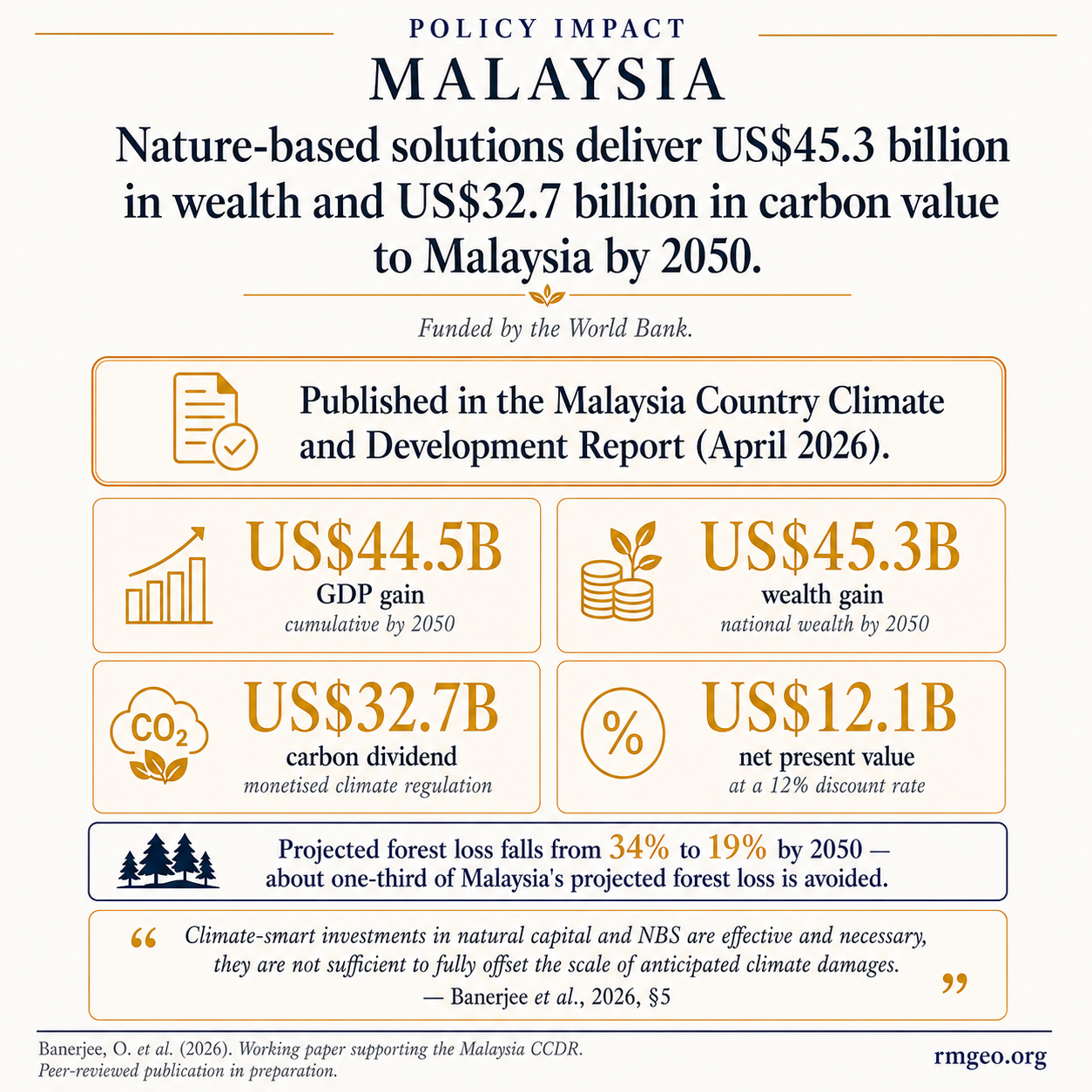
A coordinated nature-based solutions investment package would add US$44.5 billion to Malaysia’s GDP and US$45.3 billion to national wealth by 2050 — delivering US$32.7 billion in monetised climate-regulation benefits and cutting projected forest loss from 34% to 19%. The analysis was carried into the World Bank’s Malaysia Country Climate and Development Report, published two weeks after the working paper was finalised.
Malaysia has committed to net zero by 2050 and a 45% cut in greenhouse-gas emission intensity by 2030 against 2005 levels. The commitment sits inside an economy whose growth has come with rapid deforestation — much of it driven by palm oil expansion — alongside accelerating urbanisation and rising vulnerability to monsoon flooding. The World Bank needed an analytical engine for its 2026 Malaysia Country Climate and Development Report that could quantify, in one consistent framework, what unchecked climate change costs the Malaysian economy and whether a coordinated portfolio of nature-based investments would pay for itself in GDP, wealth, jobs, and ecosystem-service terms.
This is the analysis the World Bank commissioned to find out. Funded by the Bank and built as an input into the Malaysia CCDR, the working paper documents the integrated platform behind the results. The peer-reviewed publication is in preparation.
The platform built for Malaysia is a recursive-dynamic CGE engine anchored in Malaysia’s 2019 Supply and Use Tables and National Accounts, coupled to a spatial land-use change model and five ecosystem-service modules covering sediment retention, water yield, nutrient retention, carbon storage, and crop pollination. Climate damage functions for crop yields, heat and labour productivity, human health, tourism, and flooding were layered onto the macroeconomic core under two climate trajectories: Wet-Warm and Dry-Hot. Six policy scenarios were run against the baseline: gradual elimination of deforestation, System of Rice Intensification on half of Malaysia’s paddies, 100,000 hectares of new forest plantations, the simultaneous combination of all three, and each of the two climate trajectories with and without the policy package.
“Climate-smart investments in natural capital and NBS are effective and necessary, they are not sufficient to fully offset the scale of anticipated climate damages.”
— Banerjee et al., 2026, §5
Under the combined nature-based solutions package, cumulative GDP rises by US$44.5 billion and national wealth by US$45.3 billion by 2050, with a net present value of US$12.1 billion at a 12% discount rate. Forest plantations alone deliver the largest single contribution: US$32.9 billion in GDP and US$19.5 billion in wealth, more than the other two nature-based interventions combined. Projected forest loss falls from 34% under business-as-usual to 19% under the policy package — about one-third of Malaysia’s projected forest loss is avoided. Industrial palm-oil area falls by 17%, rainfed cropland by 36%. The carbon dividend from retained and new forest cover is worth US$32.7 billion at a US$20-per-tonne damage cost — more than every other ecosystem-service channel combined.
What the NBS portfolio delivers — Malaysia, cumulative to 2050
Four channels through which Malaysia’s nature-based solutions portfolio generates value by 2050 — and the reduction in projected forest loss that drives the carbon dividend.
The most important number in the paper is the one that puts the others in context. Unchecked climate change would cost Malaysia between US$870 billion and US$1.11 trillion in cumulative GDP by 2050, depending on the climate trajectory — and these figures are a lower bound. The analysis covers only some of the channels through which climate change damages an economy, and several others are not yet quantified. Among the channels included, flooding alone accounts for more of the damage than every other one combined. Against losses on that scale, even a well-designed nature-based solutions portfolio recovers only a fraction. This is the central honesty of the paper, and it is what gives the policy verdict its weight: nature-based investments are necessary, they are profitable, and they are not sufficient.
US$44.5B
Cumulative GDP gain under the NBS portfolio
US$45.3B
National wealth gain by 2050
US$32.7B
Carbon dividend from retained and new forest
US$12.1B
Net present value at a 12% discount rate
The work continues. A full-integrated run of the Dynamic OPEN IEEM+ESM Platform for Malaysia is currently in progress — the same integrated framework being deployed via rmgeo.org and now in active application across Papua New Guinea and other countries. The full run will deepen and refresh the figures above and bring in additional ecosystem-service channels not yet integrated in the April working version — flood damage mitigation, air pollutant removal, and coastal protection — alongside additional climate damage channels that the April analysis acknowledges as not yet quantified. The April analysis established that a coordinated nature-based portfolio aligned with Malaysia’s national climate commitments delivers measurable economic and natural-capital returns. The current work asks how much more, once the full platform is brought to bear, and where the residual gap relative to climate damages can be closed by complementary policy levers.
Full citation: Banerjee, O., Cicowiez, M., Muthukumara, M.S., Pollitt, H., Burli, P. (2026). Nature-Based Solutions Enhance Climate Resilience, Natural Capital and Ecosystem Services in Malaysia. Working paper, 17 April 2026. RMGEO Consultants Inc. with The World Bank. (Peer-reviewed publication in preparation.)
Companion CCDR: World Bank. (2026). Malaysia Country Climate and Development Report. Published 30 April 2026. worldbank.org