
Policy Impact
Investing in Economic-Environmental Resilience in Thailand
Built for the World Bank’s flagship Thailand climate-and-development engagement
Letting Thailand’s deforestation and climate damage run unchecked costs US$553 billion in cumulative GDP and US$178 billion in ecosystem services by 2050. The policy package aligned with Thailand’s 20-Year National Strategy turns the wealth account positive with a US$54.5 billion gain — and the single most powerful lever is eliminating deforestation, fast.
Thailand has set itself a target of joining the high-income club by 2037 under its 20-Year National Strategy. The country is also the third most climate-vulnerable in Southeast Asia, lost 2.41 million hectares of forest cover between 2001 and 2022, and saw a single flood in 2011 wipe out 12.6% of GDP. The Royal Thai Government and the World Bank needed a numerical answer to a question every Finance Ministry eventually faces: does the climate-and-environment side of the National Strategy genuinely pay for itself, or is it a competing claim on the same budget that growth-oriented spending will always win?
This is the analysis the World Bank commissioned to find out. RMGEO built the Thailand IEEM+ESM platform as the analytical input for the Bank’s engagement with the Royal Thai Government on climate and development strategy. The numerical foundation it produced sits behind two flagship World Bank publications on Thailand: Towards a Green and Resilient Thailand, and the Thailand Country Climate and Development Report. The peer-reviewed paper published in Science of the Total Environment in 2024 sets out the IEEM+ESM platform behind both.
The platform itself: a recursive-dynamic CGE engine anchored in Thailand’s National Accounts, coupled to a spatial land-use change model and to six ecosystem-service modules — sediment retention, water yield, nutrient retention, carbon storage, crop pollination, and coastal vulnerability — was layered with climate damage functions covering coastal and inland flooding, two stochastic catastrophic flood shocks, agricultural and labour productivity losses, construction-sector productivity, tourism, and sea-level rise under both moderate (RCP 4.5) and high (RCP 8.5) climate trajectories. Two scenarios were run against the baseline: a degradation pathway in which environmental decline and climate damages run unchecked, and a policy pathway aligned with the National Strategy that combines afforestation, forest restoration, the elimination of deforestation by 2037, and adaptation infrastructure.
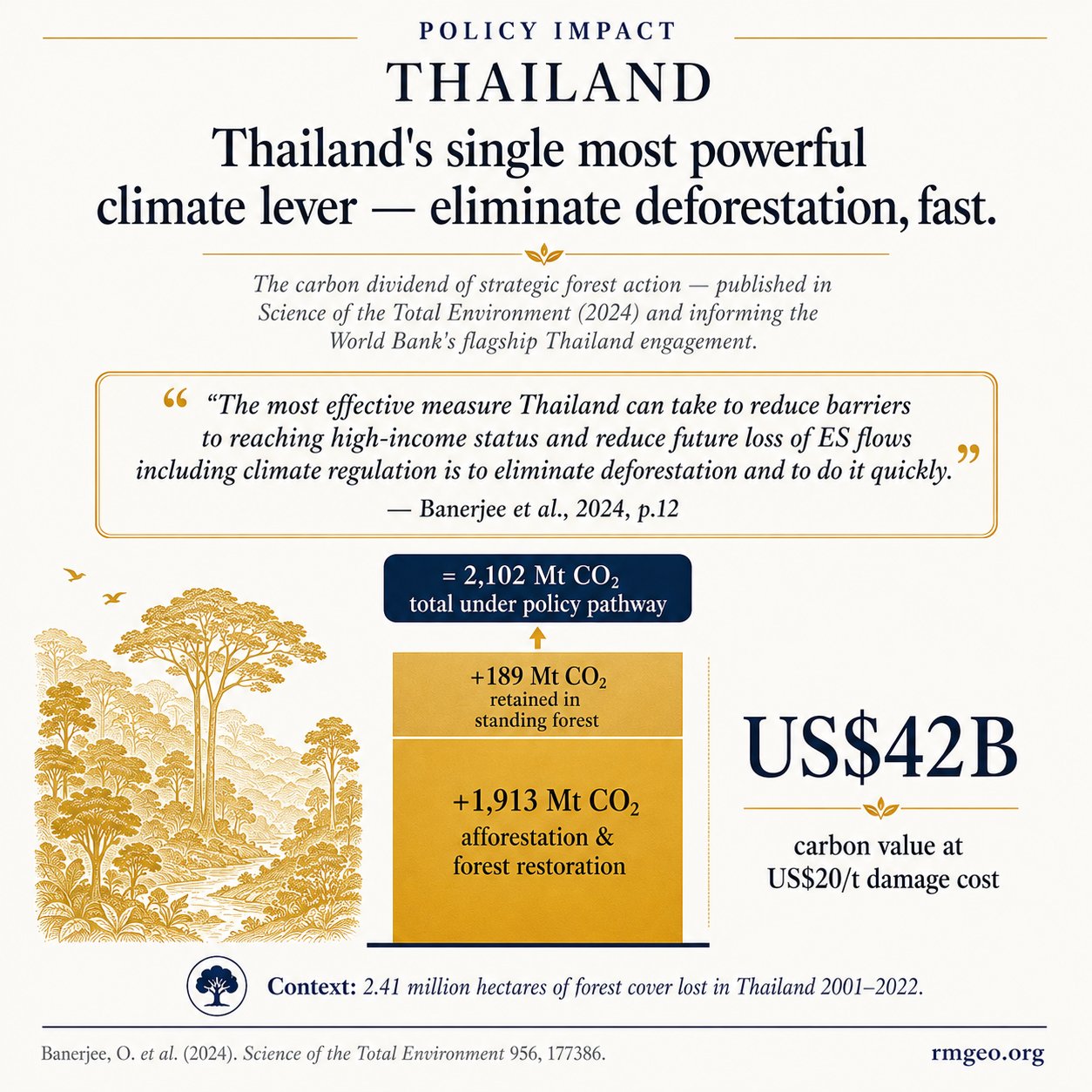
“The most effective measure Thailand can take to reduce barriers to reaching high-income status and reduce future loss of ES flows including climate regulation is to eliminate deforestation and to do it quickly.”
— Banerjee et al., 2024, p.12
Under unabated degradation, the numbers are stark. Cumulative GDP falls by US$553.7 billion by 2050. Ecosystem-service value falls by US$177.6 billion. Four point three million jobs are lost. Forty-six thousand five hundred more people are pushed into poverty. The catastrophic floods alone account for more than 74% of the climate-induced economic impact — the 2011 event was not an aberration but a preview.
The policy pathway changes the picture entirely. The GDP loss narrows to US$174.9 billion — a 68% reduction in the cumulative gap. The wealth account, which would have been deeply negative under degradation, reverses to a US$54.5 billion gain. Standing forest stock plus afforestation and restoration deliver 189 million tonnes of net CO₂ stored in retained forest and an additional 1,913 million tonnes from new tree cover — worth roughly US$42 billion at a US$20-per-tonne damage cost. The single most powerful lever is the simplest: eliminating deforestation, and doing it quickly.
What the policy pathway delivers — Thailand, cumulative to 2050
Four channels through which Thailand’s strategic-policy pathway generates value by 2050: the cumulative GDP recovered relative to unchecked degradation; the swing of the national wealth account from negative under degradation to positive under policy; the wealth account gain itself; and the value of carbon stored in retained forest and new tree cover.
The work has shaped policy dialogue at the level it was built for. Three of the paper’s seven authors are World Bank staff — two from Washington and one from the Bangkok office. The Thailand Systematic Country Diagnostic Update cites the same evidence base. The analysis is now part of the Bank’s high-level dialogue with Thailand’s Ministry of Finance, not a paper on a reading list.
The analytical approach also reaches the Bank’s institutional toolkit. RMGEO’s earlier work with the World Bank in India delivered the blueprint for integrating ecosystem services and natural capital into the MANAGE CGE model — the framework the Bank uses across many of its country programs. The Thailand work has further shaped that integration.
The platform travels too. Thailand’s coupled climate-damage functions, multi-shock architecture, and the integration of stochastic catastrophic flood shocks into a single CGE+ESM framework are now part of the Dynamic OPEN IEEM+ESM Platform being deployed via rmgeo.org — currently in active application in Papua New Guinea, Malaysia, and other countries, and delivering an updated regional analysis of the Amazon basin that builds on RMGEO’s earlier Averting a Tipping Point paper. The platform that produced these numbers is the one finance and other government ministries, planning agencies, and the multilateral institutions that work with them can now apply to their own decisions.
US$379B
GDP recovered under strategic policy
+US$55B
Wealth account reversal by 2050
5M
Jobs at stake from unabated degradation
189 Mt
CO₂ stored in retained forest cover
Read the paper → Science of the Total Environment 2024
Banerjee, O., Cicowiez, M., Honeck, E.C., Dechjejaruwat, R., Markandya, A., Pollitt, H., Muthukumara, M.S. (2024). “Arresting environmental degradation to build wealth in Thailand.” Science of the Total Environment 956, 177386.
Have a policy question we should work on together?