
Policy Impact
Investing in Water Quality in Uruguay
Empirical validation of a 2019 Inter-American Development Bank loan — multi-regional IEEM+ESM analysis
The story behind this paper is unusual. Most policy analysis is delivered into an open decision: a government considering whether to act, a development bank considering whether to lend. This one closes a loop that opened in 2019, when Onil Banerjee led the economic design of the IDB loan to the Government of Uruguay — a US$6 million investment in the National Environmental Program for Sustainable Development that would deploy riparian buffers, capacity building, and sustainable silvopastoral systems across the country’s priority watersheds.
The 2019 economic case was built with the best analytical tools then available. At that point, the integrated framework to model how a riparian buffer affects nutrient runoff, how reduced runoff flows through to coastal tourism demand, and how lower treatment loads cascade through a national economy did not yet exist as a coupled platform. The original analysis used the standard approach of its time: literature-derived parameters, carefully bounded by what was known about each channel. The loan was approved. The program was deployed across Santa Lucía, Laguna del Sauce, and Río Negro — the three watersheds that supply drinking water to Montevideo, Maldonado, and Punta del Este, plus central Uruguay’s hydropower and pulp industries.
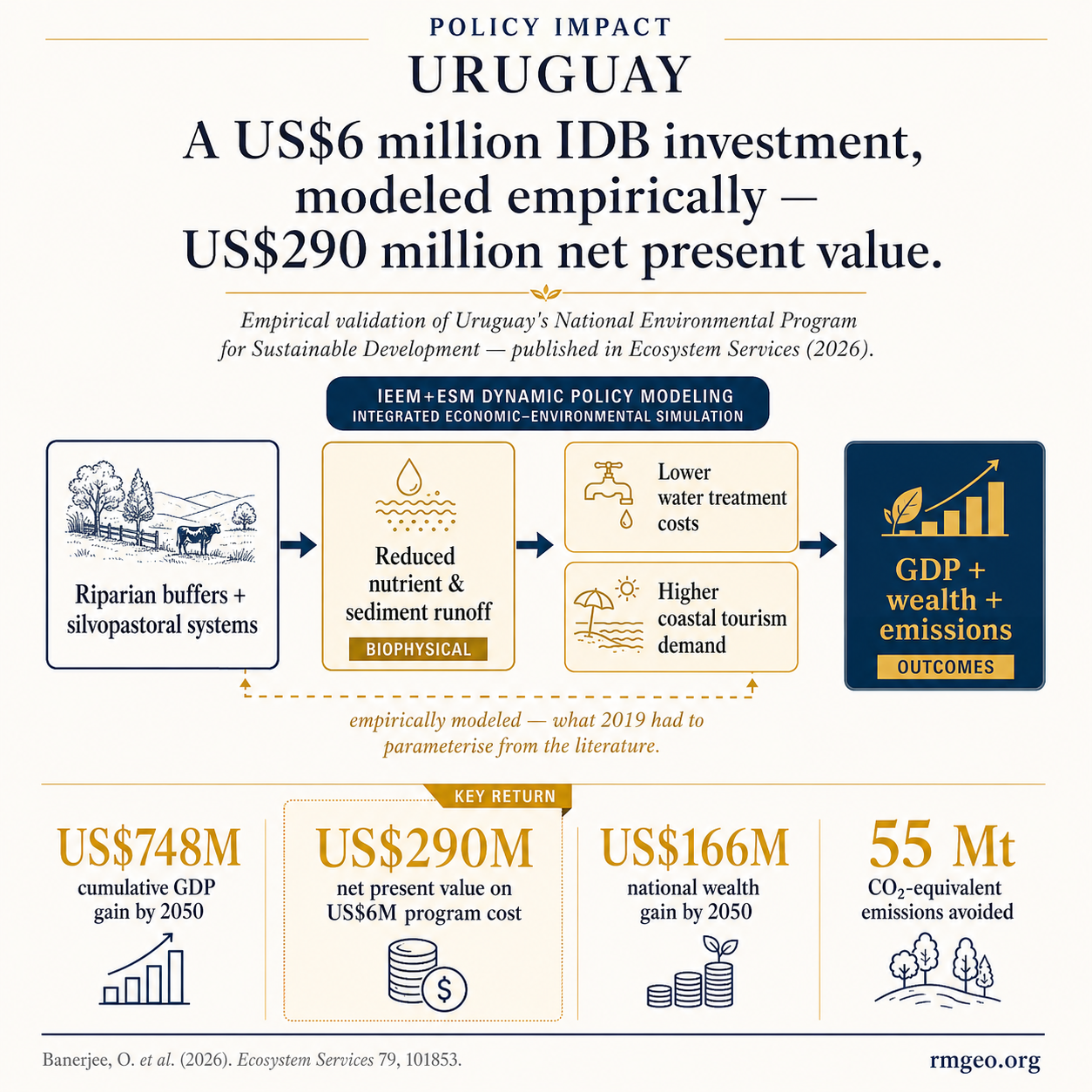
Seven years later, the tools have advanced. The 2026 paper, published in Ecosystem Services, revisits the program with the IEEM+ESM platform — and the novelty is methodological, sitting first in the causal chain. Riparian buffers and silvopastoral systems change the biophysical environment: they reduce the quantity of nutrients and sediment that reach Uruguay’s waterways. That biophysical change, modeled empirically inside a coupled framework, then drives two economic channels — lower water treatment costs for utilities serving Uruguay’s cities, and higher coastal tourism demand as water quality improves. Both channels feed back into the macroeconomic accounts via the IEEM+ESM platform’s CGE engine, resolved across all 19 of Uruguay’s Departments. The 2019 analysis had to parameterise these links from the literature. The 2026 paper models them end-to-end.
From buffer to balance sheet — the empirical causal chain
Every step from buffer placement on the landscape to GDP impact is now traced end-to-end inside a single coupled framework — sub-nationally resolved across all 19 Departments of Uruguay.
The empirical numbers strengthen the original case. The full policy package raises cumulative GDP by US$748 million and national wealth by US$166 million by 2050 — a net present value of US$290 million on the six-million-dollar program cost, well above what would normally justify a development bank investment. Regulating ecosystem services rise by US$130 million, offsetting the short-term agricultural opportunity cost of withdrawing 0.71% of Uruguay’s land area for buffers and silvopastoral systems. Net CO₂-equivalent emissions fall by 55 million tonnes, a single channel worth roughly US$1.1 billion when valued at a US$20-per-tonne damage cost — more than every other ecosystem-service channel combined.
The 19-Department resolution matters as much as the headline numbers. National-level analysis is useful for justifying a loan; sub-national analysis is what governments need to deploy one fairly. Resolving the economic impacts by Department surfaces where the agricultural opportunity costs concentrate and where the ecosystem-service gains accrue — the empirical foundation for designing equitable, spatially-targeted policies, rather than a flat national approach that asks some producers to absorb costs others escape. Pablo Kok of Uruguay’s National Directorate of Quality and Environmental Assessment is a co-author, placing the analytical capability directly inside the implementing Ministry. Independent academic work continues in the same watersheds: a 2025 study from Reyes-Bueno and colleagues surveyed riparian buffer implementation in the Santa Lucía Basin and identified the practical barriers — producer awareness, compliance, cost-sharing — that translating an empirical macroeconomic case into on-the-ground delivery will need to navigate.
The methodological contribution travels beyond Uruguay. Water purification is now part of the Dynamic OPEN IEEM+ESM Platform being deployed via rmgeo.org — the integrated framework currently in active application in Papua New Guinea, Malaysia, and other countries. The multi-regional architecture pioneered in this paper — resolving the analysis sub-nationally rather than treating a country as a single economic unit — has since been carried into work in Bolivia and across the Amazon basin. The platform that produced these numbers is the one finance and other government ministries, planning agencies, and the multilateral institutions that work with them can now apply to their own decisions.
US$748M
Cumulative GDP gain by 2050
US$166M
National wealth gain by 2050
US$290M
Net present value on US$6M program cost
55 Mt
CO₂-equivalent emissions avoided
Banerjee, O., Cicowiez, M., Bagstad, K.J., Piaggio, M., Vargas, R., Kok, P. (2026). “Water purification ecosystem services in the Integrated Economic-Environmental Model (IEEM): An application to investing in water quality in Uruguay.” Ecosystem Services 79, 101853.