Policy Impact
Can We Avert an Amazon Tipping Point? The Economic and Environmental Case for Coordinated Action
Commissioned by the Inter-American Development Bank — built into the UK Treasury’s Dasgupta Review
Coordinated action across Brazil, Peru, Colombia, Bolivia, and Ecuador to halt deforestation, intensify agriculture on cleared land, and manage fire would generate US$339.3 billion in additional cumulative wealth for the Amazon basin by 2050 — a US$29.5 billion return on the public investment required to deliver it.
The work behind this verdict was commissioned by the Inter-American Development Bank and built into the UK Treasury’s Dasgupta Review on the Economics of Biodiversity — the first comprehensive economic review of biodiversity ever commissioned by a major government. The IDB had been investing in regional Amazon programs across South America for years and needed numerical evidence of what coordinated action across the basin could deliver. The Dasgupta Review needed similar evidence at global scale. The two needs converged in a single piece of analysis.
The question both institutions were trying to answer was specific. Five countries — Brazil, Peru, Colombia, Bolivia, and Ecuador — together hold 80% of the Amazon biome. Each was making forest, land-use, and climate policy choices independently. What would the basin-scale economic and environmental return on coordinated action look like, and would the public investment required to deliver it pay back?
“While there may be some short run costs, policy action would build intergenerational wealth and enhance natural capital stocks.”
— Banerjee et al., 2022, p.10
To answer it, the team ran the IEEM+ESM platform in parallel across all five countries — one of the first multi-country applications of the framework — with the analysis resolved into 26 sub-national regions. The CGE engine was layered with statistical models linking historical crop yields to climate variability through the Maximum Cumulative Water Deficit, drought shocks indexed by the Standardized Precipitation Evapotranspiration Index, and a fire model that accounted for dry-season length and flammable-forest extent. Three scenarios were compared: a business-as-usual baseline; a degradation trajectory in which yield, drought, and fire shocks compound across the basin; and a policy pathway in which net-zero deforestation is reached within a decade at US$5.5 billion per year, climate-adapted agriculture mitigates up to half of projected productivity loss, and fire management prevents 50 to 75 percent of projected burns.
What the analysis did not attempt is as important as what it did. Several damage channels were beyond the framework’s reach in 2021: climate teleconnections affecting basin-wide rainfall patterns, microclimatic impacts on labor and agricultural productivity, and several ecosystem services not yet integrated. The numbers that follow are therefore conservative — calculated only against damage and benefit channels the platform could quantify at the time. A fuller accounting would strengthen the case for coordinated action, not weaken it.
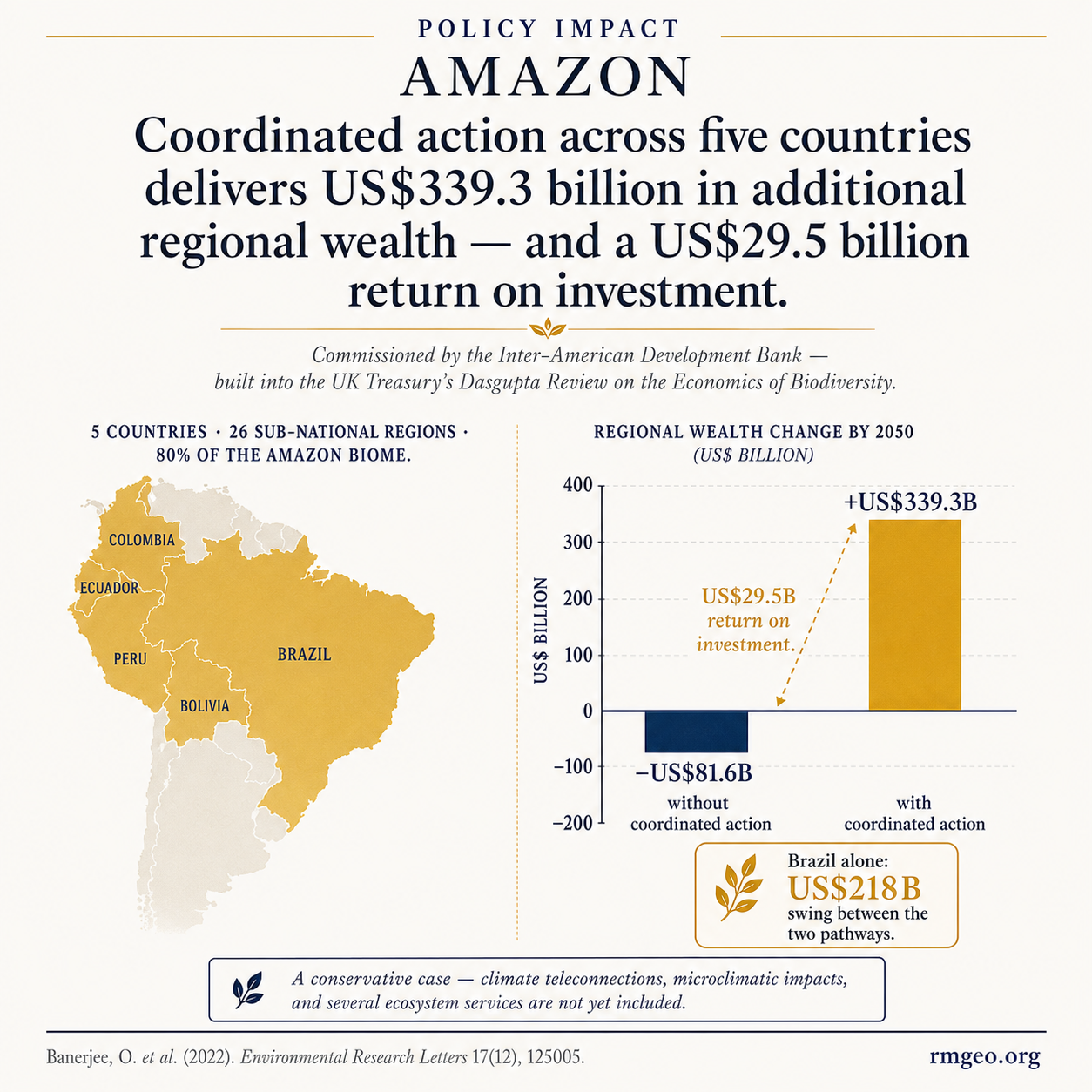
The policy verdict is striking. Across the five focal countries, coordinated action generates US$339.3 billion in additional cumulative wealth by 2050. The investment required — sustained net-zero deforestation at US$5.5 billion per year, climate-adapted agriculture, and basin-wide fire management — returns US$29.5 billion. Brazil alone, the country with by far the most basin territory and the most to lose or gain from regional coordination, sees its wealth account swing by more than US$218 billion between the two pathways. The asymmetry between what coordinated action delivers and what unilateral inaction concedes is the most important number in the analysis: protecting natural capital generates returns that scale, while letting it erode forecloses options that compound.
The work was published as an IDB Working Paper in 2021 (An Amazon Tipping Point: The Economic and Environmental Fallout) and as a peer-reviewed article in Environmental Research Letters in 2022 (Can we avert an Amazon tipping point?). It was funded by the UK Department for Environment, Food and Rural Affairs and the IDB. Two of its authors are IDB Climate Change and Sustainable Development economists, in Brasília and Washington. The Dasgupta Review’s published outputs carry the framing; the work has since been cited across academic and policy literatures, from the Vrije Universiteit Amsterdam to the US National Science Foundation public-access archive.
+US$340B
Regional wealth gain under coordinated action by 2050
US$30B
Return on a US$5.5B/year basin-scale program
5
Countries, 26 sub-national regions modeled together
80%
Of the Amazon biome held across the five focal countries
The work is now being extended. RMGEO is currently building an updated regional Amazon analysis using the Dynamic OPEN IEEM+ESM Platform deployed via rmgeo.org — the same integrated framework now in active application in Papua New Guinea, Malaysia, and other countries. The update brings in the damage channels the 2021/22 work could not: climate teleconnections affecting basin-wide rainfall and temperature, microclimatic impacts on agricultural and labor productivity, and the full suite of ecosystem services now available in the OPEN IEEM platform. The original analysis established that coordinated action across the Amazon basin delivers more value than it costs, on a conservative accounting. The new study asks how much more, once everything that was previously unquantified is brought into the picture.
Read the paper → Environmental Research Letters 2022
Banerjee, O., Cicowiez, M., Macedo, M.N., Malek, Ž., Verburg, P.H., Goodwin, S., Vargas, R., Rattis, L., Bagstad, K.J., Brando, P.M., Coe, M.T., Neill, C., Marti, O.D., Murillo, J.Á. (2022). “Can we avert an Amazon tipping point? The economic and environmental costs.” Environmental Research Letters 17(12), 125005.
Companion IDB Working Paper: Banerjee, O., et al. (2021). An Amazon Tipping Point: The Economic and Environmental Fallout. Inter-American Development Bank. DOI: http://dx.doi.org/10.18235/0003385.
Have a policy question we should work on together?